
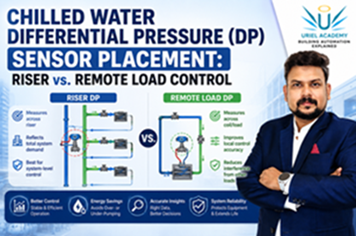
Chilled Water Differential Pressure (DP) Sensor Placement: Riser vs. Remote Load Control
Controlling variable primary or secondary chilled water pump speeds relies heavily on differential pressure (DP) feedback. Mislocating the DP sensor causes secondary pump cycling, inadequate flow at remote cooling coils, or wasted pumping energy. This guide compares riser vs. remote placement strategies for BMS design.
Controlling variable primary or secondary chilled water pump speeds relies heavily on differential pressure (DP) feedback. Mislocating the DP sensor causes secondary pump cycling, inadequate flow at remote cooling coils, or wasted pumping energy.
Understanding where and how to place differential pressure transmitters across a hydronic loop is essential for balancing energy efficiency with occupant comfort.
1. Comparison Matrix: Sensor Placement Strategies
| Location | Advantages | Disadvantages | Best Practice Use Case |
|---|---|---|---|
| Plant Header / Riser | Low installation cost; short cable runs directly to the main controller. | Pump operates against a fixed setpoint, ignoring actual branch friction losses as valves close. | Smaller, single-building hydronic loops with uniform pipe runs. |
| Most Remote Load (2/3 or 3/4 Distance) | Ensures the worst-case coil receives required delta pressure; optimizes pump power. | Longer wiring runs; potential risk of signal degradation or communication lag. | Large, spread-out chilled water networks and multi-story commercial buildings. |
| Multiple Remote Sensors (Select Minimum) | Highest energy efficiency; dynamic pump head control based on real-time coil demand. | Requires field network communication or multiple analog inputs at the controller. | Critical facilities, hospitals, and campus BMS installations. |
2. Calculating Setpoints & Preventing Pump Hunting
When positioning the DP transmitter at the 2/3 position of the longest hydraulic run:
- Setpoint Calculation: Set the DP control setpoint equal to the design pressure drop across the control valve and coil at design flow (GPM), typically 5 to 15 PSI (35 to 100 kPa).
- Proportional-Integral (PI) Tuning: Use a longer integral time constant on pump speed control loops to prevent pump hunting caused by rapid valve movements across the system.
- Fail-Safe Logic: If the remote DP sensor signal drops offline or experiences a fault, configure the BMS to default pump speed to a pre-set safe minimum (e.g., 70–80% speed) and trigger a high-priority alarm.

.jpg)
.jpg)
.jpg)
.jpg)
.jpg)
.jpg)
.jpg)

.jpg)
.jpg)


.jpg)


.jpg)
.jpg)
.jpg)
.jpg)
.jpg)
.jpg)
.jpg)
.jpg)
.jpg)
.jpg)
.jpg)
.jpg)
.jpg)
.jpg)
.jpg)
.jpg)
.jpg)
.jpg)
.jpg)
.jpg)
.jpg)
.jpg)

.jpg)
.jpg)
.jpg)
.jpg)

.jpg)
.jpg)
.png)
.png)


.png)

.png)
.png)
.png)
.png)
.png)
.png)
.png)
.png)
.png)
.png)
.png)
.png)
.png)
.png)
.png)
.png)
.png)
.png)
.png)
.png)
.png)
.jpg)
.png)