
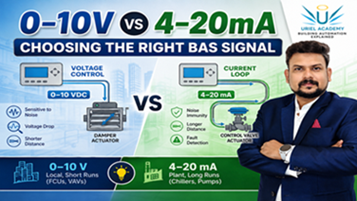
0–10V vs 4–20mA: Choosing the Right BAS Signal
Introduction
In Building Automation Systems (BAS), smooth continuous control of devices like control valves, damper actuators, and Variable Frequency Drives (VFDs) relies on Analog Outputs (AO). While Binary Outputs only handle ON/OFF states, Analog Outputs send variable signals to adjust equipment position or speed precise to the required percentage.
The two most widely used analog control signal standards in MEP/BMS design are 0–10 VDC (Voltage) and 4–20 mA (Current loop). Selecting the wrong signal type can lead to signal degradation, false readings, and erratic equipment behavior.
1. 0–10 VDC Signals (Voltage Control)
-
How It Works: The controller varies output voltage linearly from 0 volts (0% open/speed) to 10 volts (100% open/speed).
-
Where It’s Used: Short distances between the controller and the field device (e.g., VAV box damper actuators, FCU valve actuators within the same room or enclosure).
Pros:
-
Simple to wire and troubleshoot using a standard digital multimeter.
-
Low power consumption.
-
Widely supported across almost all HVAC field devices.
Cons:
-
Voltage Drop: Susceptible to voltage drop over long wire runs ($>100\text{–}150\text{ feet}$).
-
Noise Susceptibility: Electromagnetic Interference (EMI) from nearby high-voltage power lines can disrupt the signal.
2. 4–20 mA Signals (Current Loop)
-
How It Works: The controller regulates current flow through the loop. Regardless of wire resistance, $4\text{ mA}$ represents 0% and $20\text{ mA}$ represents 100%.
Why 4 mA Instead of 0 mA?
A signal below $4\text{ mA}$ (e.g., $0\text{ mA}$) immediately signals a broken wire or fault, providing built-in fault detection (Live Zero).
Pros:
-
Immune to Voltage Drop: Current remains constant throughout the loop regardless of line resistance. Ideal for long cable runs across large mechanical rooms or multi-story buildings.
-
High Noise Immunity: Less susceptible to electrical noise and EMI.
Cons:
-
Requires precise load resistor sizing ($250\ \Omega$ standard for converting to $1\text{--}5\text{ V}$) if connected to voltage-only inputs.
-
Slightly higher power consumption than voltage signals.
.jpg)
.jpg)
.jpg)
.jpg)
.jpg)
.jpg)
.jpg)

.jpg)
.jpg)

.jpg)
.jpg)
.jpg)
.jpg)
.jpg)
.jpg)
.jpg)
.jpg)
.jpg)
.jpg)
.jpg)
.jpg)
.jpg)
.jpg)
.jpg)
.jpg)
.jpg)
.jpg)
.jpg)
.jpg)
.jpg)
.jpg)
.jpg)
.jpg)
.jpg)
.jpg)
.jpg)

.jpg)
.jpg)
.png)
.png)

.png)
.png)
.png)
.png)
.png)
.png)
.png)
.png)
.png)
.png)
.png)
.png)
.png)
.png)
.png)
.png)
.png)
.png)
.png)
.png)
.png)
.png)
.jpg)
.png)